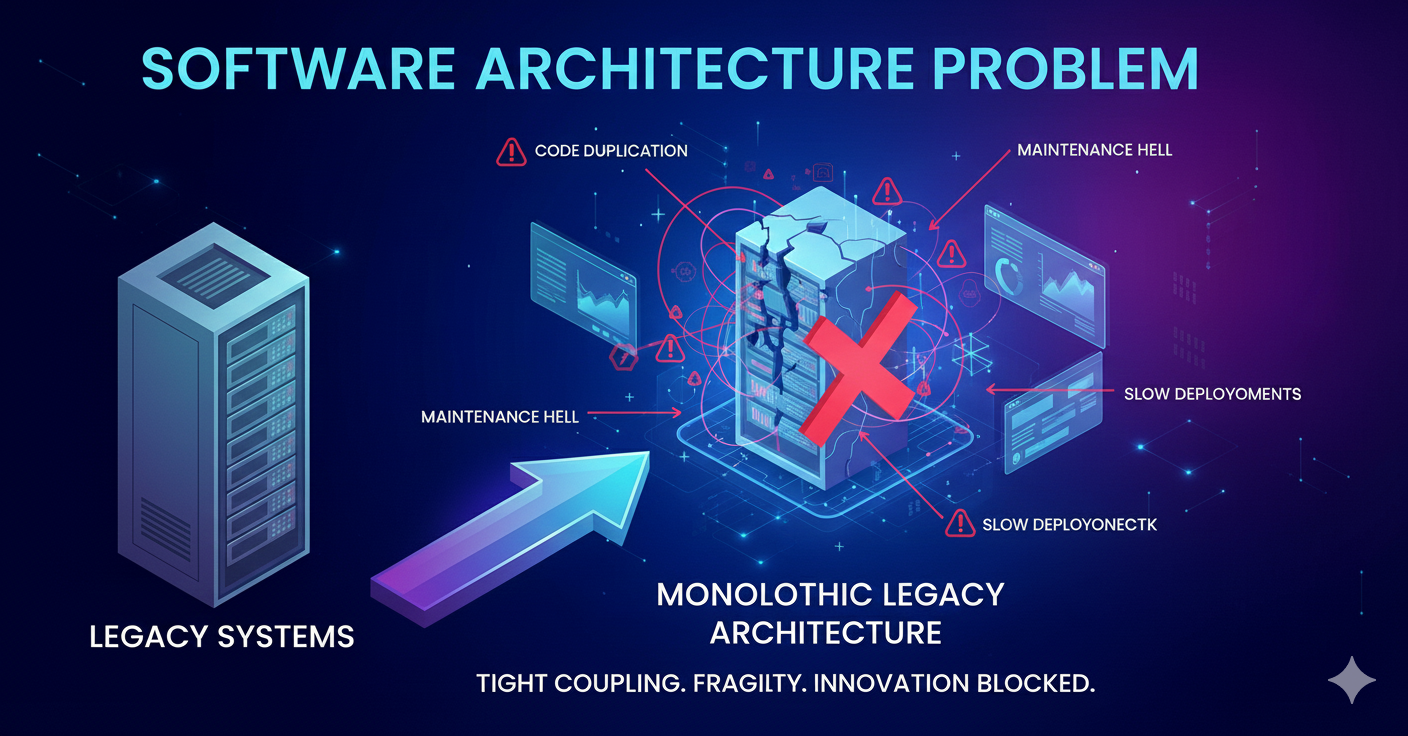
Your software started simple and flexible, but now every change takes weeks instead of hours. What began as clean, maintainable code has become a maze of dependencies that developers fear to touch. This is the architecture problem that catches most development teams off guard – when software becomes hard to change.
Software architecture problems don’t announce themselves with error messages or failed tests. They creep in quietly through rushed deadlines, quick fixes, and “temporary” solutions that become permanent. The result is rigid software architecture that slows development, increases costs, and makes your team dread Monday mornings.
This guide is for software architects, engineering managers, and development teams who want to prevent architectural technical debt before it paralyzes their projects. You’ll learn how to spot the early warning signs of inflexible software design, understand why even well-intentioned architectures become rigid over time, and discover proven strategies for software architecture refactoring that won’t break your existing systems.
We’ll cover how to measure the real impact of software maintainability issues on your team’s productivity, explore practical approaches to legacy system modernization, and share battle-tested methods for architectural lock-in prevention that keep your codebase flexible as it grows.
Recognize the Warning Signs of Rigid Software Architecture

Identify Development Velocity Decline Patterns
Development teams often notice subtle changes in their productivity before architectural rigidity becomes obvious. Sprint after sprint, stories that should take days start taking weeks. Simple bug fixes require touching multiple systems, and what used to be straightforward feature additions now demand extensive coordination meetings.
Track your team’s velocity metrics over the past six months. If you see a steady decline in story points completed per sprint, despite stable team size and experience levels, you’re likely dealing with software architecture problems. Pay special attention to tasks that involve multiple components or services – these often reveal the first cracks in your architectural foundation.
Watch for developers expressing frustration about “having to change ten files to add one simple feature.” This complaint signals that your codebase has developed tight coupling between components, making even minor modifications expensive and error-prone.
Spot Cross-Team Coordination Bottlenecks
Modern software development relies heavily on team autonomy, but rigid software architecture forces unnecessary dependencies between groups. Teams find themselves waiting for others to make changes before they can proceed with their own work.
Look for these coordination red flags:
- Multiple teams touching the same codebase for unrelated features
- Frequent “blocked” tickets in sprint boards due to external dependencies
- Teams scheduling joint deployment windows because changes can’t be released independently
- Architects becoming bottlenecks as teams constantly need approval for modifications
When teams can’t work independently on their assigned features, your architecture has become a constraint rather than an enabler. This interdependence creates a domino effect where one team’s delays impact everyone else’s delivery timelines.
Recognize Technical Debt Accumulation Indicators
Technical debt manifests differently in rigid architectures compared to flexible ones. Instead of isolated pockets of problematic code, you’ll see systemic issues that affect the entire system’s ability to evolve.
Key indicators include:
- Increasing bug counts despite stable feature development
- Tests that break frequently when unrelated code changes
- Code reviews that consistently identify the same architectural concerns
- Developers avoiding certain parts of the codebase due to complexity
- Documentation that becomes outdated faster than teams can maintain it
The most telling sign is when developers start building workarounds instead of fixing root problems. These shortcuts compound over time, creating layers of complexity that make future changes even more difficult.
Assess Feature Delivery Time Inflation
Feature delivery timelines provide concrete evidence of architectural deterioration. Compare current estimation accuracy with historical data from six to twelve months ago. If similar features now take 2-3 times longer to implement, your architecture has likely become a significant impediment.
Breaking down delivery time inflation helps pinpoint specific architectural issues:
| Time Component | Healthy Architecture | Rigid Architecture |
|---|---|---|
| Analysis & Design | 10-15% | 25-30% |
| Implementation | 60-70% | 40-50% |
| Integration & Testing | 15-20% | 30-35% |
| Deployment | 5-10% | 10-15% |
Notice how implementation time shrinks as a percentage while analysis and integration expand. This shift indicates that architectural constraints are forcing teams to spend more time understanding system interactions and managing dependencies rather than building features.
Teams start padding estimates to account for unexpected complexity, and “simple” features regularly exceed their time budgets. When estimation becomes consistently unreliable, it’s often because the underlying architecture makes change prediction nearly impossible.
Understand Why Software Architecture Becomes Inflexible Over Time

Examine Short-Term Decision Making Pressure
Business deadlines create a relentless pressure cooker where architectural technical debt accumulates faster than teams can address it. When executives demand features yesterday, developers make quick fixes that seem harmless in isolation but compound into architectural nightmares over time.
The “just this once” mentality spreads like wildfire through development teams. A quick hardcoded value becomes the template for future shortcuts. Database queries that bypass established patterns become the new norm. Each compromise feels justified by urgent business needs, but these decisions gradually transform flexible software design into rigid, unmaintainable systems.
Resource constraints amplify the problem. Teams working with tight budgets and skeleton crews rarely have time to step back and evaluate the long-term impact of their architectural choices. They focus on immediate functionality while architectural integrity slowly erodes beneath the surface.
Market competition adds another layer of pressure. Companies racing to beat competitors to market often sacrifice architectural planning for speed. This creates software architecture problems that manifest months or years later when the codebase becomes increasingly difficult to modify or extend.
Analyze Component Coupling Evolution
Components that start life as independent, loosely coupled modules gradually become entangled in ways that make rigid software architecture inevitable. This coupling evolution happens through small, seemingly innocuous changes that accumulate over time.
Direct dependencies multiply as teams take shortcuts during feature development. A payment module that initially communicated through well-defined interfaces suddenly starts accessing user data directly. An authentication service begins reaching into the database layer without going through proper abstractions. Each shortcut creates invisible threads that bind components together.
Data sharing patterns contribute significantly to coupling evolution. Shared databases, global state variables, and common data structures create hidden dependencies between modules. When one team modifies a shared data structure, other components break in unexpected ways, revealing the tangled web of implicit connections.
| Coupling Type | Initial State | Evolved State | Impact |
|---|---|---|---|
| Data Coupling | Shared interfaces | Shared databases | High maintenance |
| Temporal Coupling | Independent execution | Synchronized workflows | Deployment complexity |
| Spatial Coupling | Separate deployments | Monolithic releases | Scaling difficulties |
Event-driven architectures can also evolve into tightly coupled systems when teams bypass proper messaging patterns. Direct method calls replace event publishing, breaking the loose coupling that made the system maintainable in the first place.
Evaluate Knowledge Silos Formation
Knowledge concentration around specific team members creates architectural rigidity that persists long after the original technical decisions. When only one person understands how critical components work, modifications become risky ventures that teams actively avoid.
Documentation gaps accelerate knowledge silo formation. Complex architectural decisions remain trapped in individual minds rather than being captured in accessible formats. New team members struggle to understand system interconnections, leading them to work around existing patterns rather than extending them properly.
Team turnover compounds the problem exponentially. When key architects leave without proper knowledge transfer, remaining team members inherit systems they fear to modify. This fear drives teams toward workarounds and parallel implementations rather than improving existing components.
Specialized expertise creates natural boundaries that harden into architectural walls. The database expert, the frontend specialist, and the infrastructure guru each develop deep knowledge in their domains while losing sight of the bigger picture. Cross-team collaboration suffers, and components become increasingly isolated.
Code ownership models contribute to knowledge silos when teams become overly protective of their modules. Instead of sharing knowledge and maintaining consistent patterns across the system, teams develop their own coding styles and architectural approaches.
Understand Legacy System Integration Challenges
Legacy systems act like architectural anchors, dragging new development toward inflexible software design patterns. These systems often use outdated technologies, protocols, and data formats that force modern components to adapt to their limitations rather than embracing contemporary architectural principles.
Integration complexity multiplies when multiple legacy systems need to communicate with new components. Each legacy system brings its own set of constraints, communication protocols, and data transformation requirements. The resulting integration layer becomes a complex web of adapters, converters, and compatibility shims that resist change.
Data migration challenges create additional architectural constraints. Legacy databases with decades of accumulated data cannot be easily modernized without significant business disruption. New systems must accommodate old data structures, maintaining backward compatibility that prevents architectural evolution.
Business process dependencies embedded in legacy systems create functional lock-in that extends beyond technical considerations. Critical business workflows often rely on specific legacy system behaviors that cannot be replicated exactly in modern architectures. This forces new systems to maintain compatibility with outdated processes.
Risk aversion surrounding legacy systems creates a culture of minimal change. Organizations become afraid to modify systems that “work,” even when those systems constrain overall architectural flexibility. This conservative approach perpetuates software maintainability issues and prevents necessary modernization efforts.
Vendor relationships and licensing agreements add external pressure to maintain legacy system integration. Long-term contracts with software vendors create economic incentives to preserve existing integrations rather than pursuing architectural improvements that might require expensive migrations or license renegotiations.
Measure the True Cost of Architectural Rigidity
Calculate Developer Productivity Loss
When software architecture problems start creeping into your codebase, the first place you’ll notice the damage is in your development team’s productivity. Tracking this decline requires looking beyond surface-level metrics like lines of code written per day.
Start by measuring how long simple feature additions take compared to six months ago. A feature that once took two days might now require a full week because developers spend most of their time navigating architectural constraints. Document the time spent on workarounds – those creative but inefficient solutions developers create when the existing structure fights against new requirements.
Track debugging time as a percentage of total development effort. In rigid software architecture, developers often spend 60-70% of their time hunting down bugs that exist because of tight coupling and unclear dependencies. Compare this to healthy codebases where debugging typically consumes 20-30% of development time.
Monitor code review cycles. When architectural technical debt accumulates, pull requests become nightmares. Reviews that should take 30 minutes stretch into multi-hour discussions about how to fit square pegs into round holes. Count how many times developers say “we can’t do that because…” – each instance represents architectural friction costing you money.
Quantify Market Opportunity Costs
Inflexible software design doesn’t just slow down your team – it actively blocks revenue opportunities. Calculate the business value of features you’ve postponed or abandoned because your architecture couldn’t support them.
Track your competitor response time. When competitors launch new features, how long does it take your team to match them? If your answer involves months instead of weeks, architectural rigidity is costing you market share. Document specific customer requests you couldn’t fulfill due to software maintainability issues.
Measure deployment frequency and lead time. Companies with flexible architectures deploy multiple times per day, while those suffering from monolithic architecture challenges might deploy monthly or quarterly. Each delayed deployment represents missed opportunities to capture market feedback and iterate based on real user needs.
Calculate the cost of maintaining separate codebases for different platforms or regions. Rigid architectures often force teams to duplicate functionality instead of sharing it, multiplying development costs and creating maintenance nightmares.
Assess Customer Satisfaction Impact
Your customers feel the pain of rigid architecture even when they don’t understand why. Performance degrades as developers add layer upon layer of workarounds. Simple user requests become impossible to implement, forcing you to tell customers “our system doesn’t support that” repeatedly.
Track support ticket volume and resolution time. Legacy system modernization becomes urgent when customer complaints spike because basic functionality breaks whenever you touch the code. Monitor how often you have to tell customers to wait for the “next major release” instead of delivering quick fixes.
Measure feature request fulfillment rate. When software becomes hard to change, your product roadmap becomes a wishlist instead of a plan. Count how many customer-requested features remain in your backlog for months because implementation would require major architectural changes.
Document user experience degradation. Page load times increase, mobile responsiveness suffers, and integration capabilities shrink as architectural constraints pile up. Each of these issues directly impacts customer satisfaction and retention rates.
Evaluate Team Morale and Retention Effects
The human cost of architectural lock-in prevention failures extends far beyond productivity metrics. Talented developers get frustrated when they spend their days fighting the system instead of building innovative solutions.
Track developer satisfaction surveys specifically around codebase quality and development experience. Watch for phrases like “everything is connected to everything” or “I’m afraid to change anything.” These indicate architectural problems are affecting team morale.
Monitor turnover rates, especially among senior developers. Experienced engineers recognize the signs of technical debt spiraling out of control and often leave before the situation becomes unbearable. Exit interviews frequently reveal that developers left because they felt their skills were being wasted on maintenance instead of meaningful development.
Count the number of times team members express reluctance to work on certain parts of the codebase. When developers start avoiding specific modules or components, you’re looking at architectural problem areas that need immediate attention.
Measure recruitment difficulty. As word spreads about your technical challenges, attracting top talent becomes harder. Candidates often ask pointed questions about code quality, deployment practices, and technical debt during interviews – their concerns reflect your architecture’s reputation in the developer community.
Apply Proven Strategies to Prevent Architecture Lock-in
Implement Modular Design Principles
Breaking your software into independent, self-contained modules creates natural boundaries that make changes easier and safer. Each module should handle one specific business capability or technical concern, with clear inputs and outputs that other parts of the system can rely on.
Start by identifying logical groupings in your current codebase. Look for features that change together or serve similar business functions. User authentication, payment processing, and inventory management should live in separate modules with their own data stores and business rules.
The key is making each module replaceable without breaking everything else. When you need to swap out your payment processor or upgrade your authentication system, you should be able to do it module by module instead of rewriting the entire application. This prevents the architectural lock-in prevention problems that plague monolithic architecture challenges.
Design modules to be as independent as possible. Avoid sharing databases between modules, and resist the urge to create “utility” modules that everyone depends on. These shared components become bottlenecks that make changes ripple across your entire system.
Establish Clear Boundaries and Interfaces
Well-defined interfaces act as contracts between different parts of your system. When these contracts stay stable, you can change the internal workings of any component without affecting others. This isolation protects you from software architecture problems that make simple changes require massive rewrites.
Create API contracts that focus on what data flows between components, not how those components work internally. A user service might expose functions for creating, updating, and retrieving user data, but the calling code shouldn’t know whether that data lives in PostgreSQL, MongoDB, or a third-party service.
Version your interfaces from day one, even if you think they’ll never change. When you do need to modify an interface, the versioning system lets you support both old and new versions during the transition period. This prevents the all-or-nothing upgrades that create rigid software architecture problems.
Document the purpose and guarantees of each interface. What data formats does it expect? What errors might it return? What performance characteristics can callers rely on? Clear documentation prevents teams from making assumptions that create hidden dependencies.
Create Automated Testing Safety Nets
Comprehensive testing gives you confidence to make changes without breaking existing functionality. Without this safety net, even small modifications become risky, leading to software maintainability issues that slow development to a crawl.
Build tests at multiple levels. Unit tests verify individual functions work correctly. Integration tests check that modules communicate properly. End-to-end tests confirm the whole system delivers business value. Each level catches different types of problems and gives you different confidence levels when making changes.
Focus your testing energy on the boundaries between components. These integration points are where inflexible software design problems usually start. When Module A stops working with Module B after an update, you want to catch that immediately, not when customers start complaining.
Set up automated testing that runs on every code change. Modern CI/CD systems can run your full test suite in minutes, giving you immediate feedback about whether your changes broke anything. This fast feedback loop prevents small problems from becoming big architectural technical debt issues.
Build Documentation and Knowledge Sharing Practices
Knowledge trapped in one person’s head creates single points of failure that make systems harder to change. When only one developer understands how the authentication system works, any changes to that system become high-risk operations.
Document architectural decisions along with the reasoning behind them. Future developers need to understand not just what the current design does, but why those choices were made. This context helps them make changes that work with the existing design instead of against it.
Create onboarding processes that spread architectural knowledge across your team. Code reviews, architecture discussions, and regular knowledge-sharing sessions help everyone understand how the pieces fit together. When multiple people understand each component, changes become less risky.
Keep your documentation close to your code. README files, inline comments, and architecture decision records stored in the same repository as your code are more likely to stay accurate than external wikis or documents. This proximity makes it easier to update documentation when you change the code.
Transform Existing Rigid Systems into Flexible Architectures
Develop Safe Refactoring Strategies
Breaking down monolithic architecture challenges requires surgical precision rather than sledgehammer approaches. Start with comprehensive test coverage before touching any production code. Create automated regression tests that capture current system behavior, even if that behavior seems imperfect. These tests become your safety net during architectural technical debt reduction.
Map your system’s dependencies using dependency visualization tools. Draw clear boundaries around modules that can be safely isolated without breaking critical business functions. Focus on areas with high coupling but low cohesion – these represent the biggest architectural pain points and offer the most reward when refactored properly.
Implement feature toggles to control new architectural patterns alongside legacy code. This strategy lets you test architectural changes in production without risking system stability. When software becomes hard to change due to tight coupling, feature flags provide breathing room to validate new approaches incrementally.
Branch by abstraction works particularly well for replacing core system components. Create an abstraction layer around the component you want to replace, then gradually migrate callers to use the new interface. Once all dependencies flow through the abstraction, swap out the underlying implementation without disrupting the system.
Implement Gradual Migration Techniques
Database schema evolution presents unique challenges in rigid software architecture scenarios. Use database migration scripts that support both old and new schema formats simultaneously. Maintain dual-write capabilities where your application writes to both legacy and new structures until migration completes.
The strangler fig pattern slowly replaces legacy functionality by intercepting requests and routing them to new services. Set up a reverse proxy or API gateway that directs traffic based on feature maturity. Start with non-critical features, gradually expanding the new system’s responsibility as confidence builds.
| Migration Technique | Best Use Case | Risk Level |
|---|---|---|
| Feature Toggles | UI/UX Changes | Low |
| Strangler Fig | Service Replacement | Medium |
| Branch by Abstraction | Core Components | Medium |
| Database Dual-Write | Data Layer Changes | High |
Event-driven architecture helps decouple systems during migration. Introduce an event bus that captures business events from the legacy system. New services can subscribe to these events and build their own data models independently. This approach reduces direct dependencies while enabling new functionality to coexist with legacy processes.
Create Parallel System Approaches
Running parallel systems requires careful resource planning and monitoring. Start by identifying business processes that can operate independently without cross-system dependencies. Customer onboarding, reporting, and configuration management often work well as parallel system candidates.
Shadow traffic techniques let you test new architectural patterns with real production data without affecting user experience. Clone incoming requests and send copies to your new system while continuing to serve responses from the legacy application. Monitor performance, accuracy, and error rates to validate the new architecture handles real-world scenarios.
Blue-green deployments become essential when transitioning between architectural paradigms. Maintain two identical production environments where you can switch traffic instantly if problems arise. This approach works particularly well for software architecture refactoring projects where rollback needs happen quickly.
Data synchronization strategies make or break parallel system implementations. Implement eventual consistency patterns using message queues or change data capture. Accept that some data lag exists between systems, but ensure business-critical operations maintain accuracy across both environments.
Legacy system modernization succeeds when you resist the temptation to replace everything simultaneously. Choose specific business capabilities to migrate first, typically those with clear boundaries and minimal dependencies. Customer authentication, payment processing, and notification systems often serve as good starting points for parallel implementation approaches.
Rigid software architecture doesn’t happen overnight – it creeps up on development teams through seemingly harmless shortcuts and quick fixes that eventually pile up into a maintenance nightmare. The warning signs are often there long before systems become completely inflexible, from increasing development times to developers avoiding certain parts of the codebase altogether. When teams recognize these red flags early and understand the root causes behind architectural rigidity, they can take action before small problems become expensive, time-consuming disasters.
The good news is that architectural flexibility isn’t just a nice-to-have feature – it’s a competitive advantage that pays dividends over time. Start by measuring the real impact of rigid architecture on your team’s productivity and your company’s bottom line. Then implement strategies like modular design, clear interfaces, and regular architectural reviews to keep your systems adaptable. If you’re already dealing with a rigid system, remember that transformation is possible with the right approach and commitment. Your future self (and your development team) will thank you for making flexibility a priority today.